

Are you scanning the road... or just looking around?
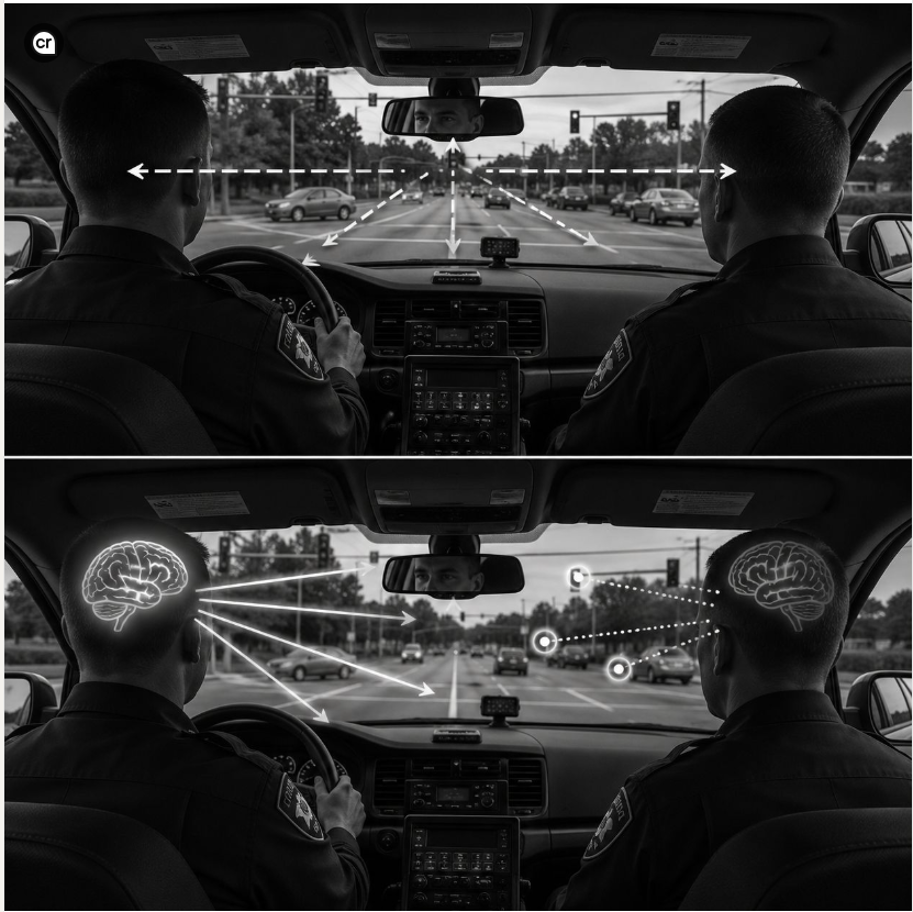
"Two drivers. Same eye movement, same head turn, same mirror checks.
 One of them is reading the road. The other is waiting for it to shout..."
– Hugh Anderson, Police Driver Training Specialist
With our unique Arrive & Drive™ Crash Course programme, I guide internationals and expats with a foreign driving licence every day towards obtaining a Dutch driving licence.
Almost all of them come to us with years of driving experience. But driving experience is a broad concept. How experienced are you really when you suddenly find yourself driving in a completely new traffic environment? A new road infrastructure with different traffic rules. A different driving culture. New traffic situations and road users who behave differently from what you're used to.
That is why both the willingness and the ability to adapt your driving behaviour to a new traffic environment are so important. This is one of the key skills we focus on within Arrive & Drive™.
Being open to looking at driving from a different perspective enables me to do my job as a driving instructor: helping internationals drive safely in Dutch traffic while meeting the practical exam standards of the CBR.
Are you scanning the road... or just looking around?
In the two illustrations above, we see two different types of drivers: a problem-solving driver and an anticipating driver.
From the passenger seat, they appear to be doing exactly the same thing. Both are constantly looking around.
The problem-solving driver moves their eyes around and waits for something to attract their attention. Only then do they react.
Movement. Contrast. Brake lights.
The eyes detect it, send the information to the brain, and the brain decides what needs to happen next. This is called bottom-up processing. Many drivers rely on this way of driving.
In a new traffic environment, you often depend on it even more because your brain has not yet built enough experience to recognise and predict risks at an early stage.
The anticipating driver works in exactly the opposite way. Their brain uses knowledge, experience and expectations to predict where a risk is most likely to develop. The brain then deliberately directs the eyes towards that location, before anything has actually happened. This is known as top-down processing.
Imagine approaching a traffic light that has been green for quite some time. The anticipating brain thinks: check the lane for vehicles turning left. Not because something is moving there, but because that's where the potential risk is at this intersection. That same risk was there yesterday and will most likely be there again tomorrow.
The problem-solving driver only notices the turning vehicle once it actually starts moving. By then, the situation is already making the decision for them.
The anticipating driver looked there long before that. They had already positioned the car correctly and already had their foot hovering above the brake pedal. In the end, nothing happened—simply because they never allowed the situation to develop into a problem.
Both drivers constantly scan their surroundings. But only one of them does so with purpose.
Which driver do you recognise yourself in? 😊
The problem-solving driver?
You wait until a traffic situation develops before reacting. You solve problems instead of preventing them.
In Dutch traffic, this often looks like:
- You see the brake lights of the car ahead and only then start braking.
- You see a pedestrian stepping onto a pedestrian crossing (zebra crossing) and brake abruptly.
- You notice a vehicle approaching from the right at an equal-priority intersection and only react at that moment.
It's important to understand:
That a problem-solving driver is not necessarily an inexperienced driver. Many motorists with 10, 20 or even 30 years of driving experience still drive largely this way. The difference is therefore not measured by the number of years behind the wheel, but by how you observe, interpret and process traffic situations.
The anticipating driver?
You use your knowledge, experience and expectations to determine where to look and what to expect before a traffic situation even develops.
- You notice traffic slowing down further ahead and ease off the accelerator before the vehicle in front even needs to brake.
- You see someone walking towards a zebra crossing and lift off the accelerator before they step onto it.
- You know that traffic from the right has priority, so you deliberately check that direction, even when no vehicle is visible yet.
So it is not years of driving experience alone that define you as a driver. What matters far more is the way you think while driving.
Don't wait for traffic to tell you what to do. Read the traffic before it says anything.
No matter where in the world you are driving.
To me, that is the kind of driving experience that is truly valuable.
Are you scanning the road... or just looking around?
Based on a post by Hugh Anderson, Police Driver Training Specialist. Shared with permission and further developed for Arrive & Drive™.
